
You spend a good five minutes coating your lashes, everything looks crisp, and then two hours later you catch your reflection and there’s a grey shadow smudged right under your eyes. Sound familiar?
It’s one of the most common makeup frustrations out there, and it happens to people with all skin types, all lash lengths, and every budget of mascara. The annoying part is that most of us blame the mascara itself when the real culprit is usually somewhere else entirely.
Let’s get into what’s actually going on beneath your eyes, why even waterproof formulas can betray you, and the practical steps that stop the smudge for good.
The Real Reasons Mascara Smears Under Your Eyes
Mascara transfer isn’t random. There’s almost always a mechanical or chemical reason behind it. The pigment lifts off your lashes and lands on the skin below because something is loosening it up throughout the day.
The biggest offenders are moisture and oil. Your under-eye area produces natural oils, and that thin skin also holds moisture.
When the mascara formula meets that slick surface, it starts to break down and travel. Every time you blink, your lower lashes brush against the skin, and that contact leaves a mark.
Here are the most common causes:
- Oily skin or an oily under-eye area that breaks down the formula
- Watery eyes, whether from allergies, wind, or just naturally teary eyes
- Heavy or greasy eye creams applied too close to your lash line
- Rubbing or touching your eyes during the day
- Applying too much mascara so it never fully sets
- Using a formula that doesn’t suit your skin chemistry
- Skipping a setting step like powder or primer
Humidity plays a role too. On a hot, sticky day your makeup breaks down faster because sweat and moisture on the skin give the pigment somewhere to go. If you’ve noticed your mascara smudging worse in summer than in winter, that’s why.
One thing worth understanding: mascara that transfers to the upper eyelid usually comes from the same issue as under-eye smudging. It’s oil and blinking. Deep-set eyes and hooded lids are especially prone because the lid physically touches the lashes more often.
Why Waterproof Mascara Still Smudges
This one surprises people. You’d think waterproof mascara would be immune, but plenty of folks find their waterproof formula smearing just as badly as regular. The name is a bit misleading.
Waterproof mascara resists water. It does not necessarily resist oil.
And oil, not water, is what breaks down mascara on most under-eye skin. If your under-eye is oily or you’re using a rich eye cream, that waterproof formula can still lift and slide.
There’s another factor. Waterproof formulas tend to be heavier and take longer to fully set. If you apply concealer, powder, or touch your eyes before it’s completely dry, you can actually smudge it yourself in those first few minutes.
According to the American Academy of Dermatology, the skin around the eyes is thinner and more delicate than the rest of the face, which is why it holds moisture and reacts differently to products.
So if your waterproof mascara is smudging under your eyes, the fix usually isn’t a stronger waterproof formula. It’s controlling the oil and moisture underneath.
How Your Skincare and Eye Products Sabotage You
This is the section most people overlook, and honestly it fixes half of all smudging problems. What you put on your skin before makeup matters enormously.
Eye creams are the classic offender. They’re designed to be moisturising and slightly greasy, and that’s great for your skin at night. But if you slather a rich eye cream right up to your lower lash line and then apply mascara, you’ve basically laid down a slippery runway for the pigment to slide onto.
The same goes for heavy under-eye concealer that never gets set with powder. A creamy, dewy concealer stays tacky, and mascara loves to stick to tacky surfaces.
A few adjustments make a real difference:
- Apply eye cream at least 10 to 15 minutes before makeup, and use a pea-sized amount
- Keep rich creams away from the immediate lower lash area
- Set your under-eye concealer with a light dusting of translucent powder
- Blot excess oil before you even start with mascara
- Let each layer dry before moving to the next step
Powder is genuinely your best friend here. A thin veil of translucent powder under the eyes absorbs the oil and gives the whole area a matte, dry finish that mascara can’t easily grab onto. This one small step transforms the wear time for a lot of people.
Choosing a Formula That Actually Stays Put
Not all mascaras are built the same, and the type you pick has a huge impact on whether you’ll be dealing with smudges by lunchtime. If you’ve tried everything and nothing works, the formula itself might be wrong for you.
Tubing mascara is the standout option for smudge-prone eyes. Instead of coating your lashes with pigment that can flake or slide, tubing formulas wrap each lash in tiny polymer “tubes.” These tubes cling on and only come off with warm water and a bit of gentle pressure.
No oil breakdown, no midday transfer. Many people who’ve struggled for years find that switching to a tubing mascara solves the problem almost overnight.
Here’s a quick comparison of the main types:
| Mascara Type | Smudge Resistance | Removal | Best For |
|---|---|---|---|
| Regular (washable) | Low to moderate | Cleanser or water | Dry skin, short wear |
| Waterproof | Good against water, weak against oil | Oil-based remover | Humidity, tears, swimming |
| Tubing | Excellent | Warm water, gentle rubbing | Oily skin, all-day wear, watery eyes |
| Buildable volumizing | Varies, can be heavy | Depends on base formula | Dramatic looks, dry lids |
If you love volume, look for a buildable formula that dries down quickly rather than one that stays wet and wet-looking. The longer a product takes to set, the more chance it has to migrate.
Application Habits That Stop the Smudge
How you apply mascara matters as much as what you’re applying. Even a great formula smears if your technique works against it.
First, easy on the lower lashes. This is where most under-eye smudging starts. Your lower lashes sit closest to the skin and brush against it constantly when you blink.
Try applying just one light coat on the bottom, or skip them entirely and focus your drama on the top lashes. A lot of people find their smudging disappears the moment they stop piling product on the bottom.
Second, don’t overload the top lashes either. More mascara isn’t more staying power.
Thick, wet layers take forever to dry and are far more likely to flake and transfer. Two thin coats beat one heavy one every time.
A solid routine looks like this:
- Prep and let eye cream fully absorb
- Apply and set concealer with powder
- Curl your lashes before mascara, never after
- Use a lash primer if you want extra hold
- Apply one thin coat, wait, then a second on top lashes
- Go very light on lower lashes
- Let everything dry fully before you do anything else
Curling matters, oddly enough. Lashes that point down or sit close to the skin transfer pigment more easily. Curled lashes lift away from your face and simply have less contact with the under-eye area.
And resist the urge to touch
And resist the urge to touch or rub your eyes during the day. It sounds obvious, but a lot of smudging is self-inflicted from an absent-minded rub.
How to Get Rid of Mascara Smudges Without Ruining Your Makeup
Sometimes the smudge happens anyway. You don’t need to redo your whole face. There’s a quick fix that takes seconds.
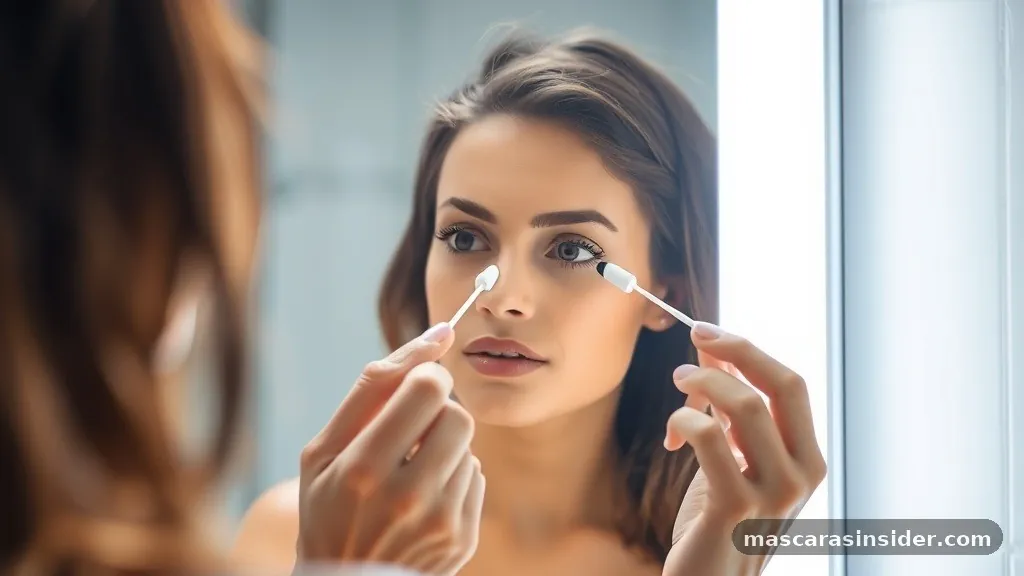
Grab a clean cotton swab. Wait until the mascara smudge is fully dry, because trying to wipe wet mascara just spreads it around and makes a bigger mess.
Once it’s set and flaky, gently roll or flick the dried flakes away with the dry swab. They lift right off without disturbing the concealer underneath.
For anything more stubborn, dip the tip of the swab in a tiny bit of micellar water and carefully lift the mark. Then dab a touch of concealer and re-set with powder. Keep a few cotton swabs in your bag and this becomes a 20-second touch-up.
To reduce midday smudging going forward, blotting papers help too. A quick press over the under-eye area removes the oil that causes the transfer before it has a chance to build up.
Frequently Asked Questions
Why does my mascara smudge under my eyes throughout the day but not right away?
Because it’s oil and moisture doing the work over time. In the morning your skin is fresh and matte. As the hours pass, natural oils rise to the surface, your eyes may water slightly, and every blink transfers a little pigment.
By afternoon that adds up to a visible smudge. Setting the area with powder and using a tubing formula slows this dramatically.
Why does my waterproof mascara still smudge under my eyes?
Waterproof mascara resists water, not oil. If your under-eye skin is oily or you’re using a rich eye cream, the oil breaks the formula down and it slides regardless of the waterproof label. Controlling oil with powder or switching to a tubing mascara usually works better than reaching for a stronger waterproof product.
Should I stop applying mascara to my lower lashes?
For smudge-prone eyes, yes, either skip them or go very light. Lower lashes sit right against the skin and brush it constantly when you blink, which is a major source of under-eye smudging. Focusing the drama on your top lashes gives a defined look without the mess.
Does the type of concealer I use affect mascara smudging?
Absolutely. A creamy, dewy concealer that stays tacky gives mascara pigment something to cling to.
Set your under-eye concealer with a light dusting of translucent powder so the surface is dry and matte. This one step prevents a lot of transfer.
Is tubing mascara really better for stopping smudges?
For most people who struggle with smearing, yes. Tubing formulas wrap the lash in polymer tubes that resist oil and only slide off with warm water. Because oil is the main cause of under-eye smudging, tubing mascara tends to outperform both regular and waterproof options for all-day wear.
The Bottom Line
So why does your mascara smear under your eyes? Nine times out of ten it comes down to oil, moisture, and blinking, not the mascara being defective. The skin under your eyes gets slightly oily or watery, your lower lashes brush against it, and the pigment travels.
The fixes are refreshingly simple. Set your under-eye area with translucent powder, keep rich eye creams away from the lash line, go light on the bottom lashes, and let every layer dry before moving on. If smudging still plagues you after all that, switch to a tubing mascara and watch the problem largely disappear.
Small tweaks, big difference. Once you figure out which factor is causing your particular smudge, you can enjoy a clean, defined lash look that actually lasts through the day, no cotton-swab rescue mission required.