
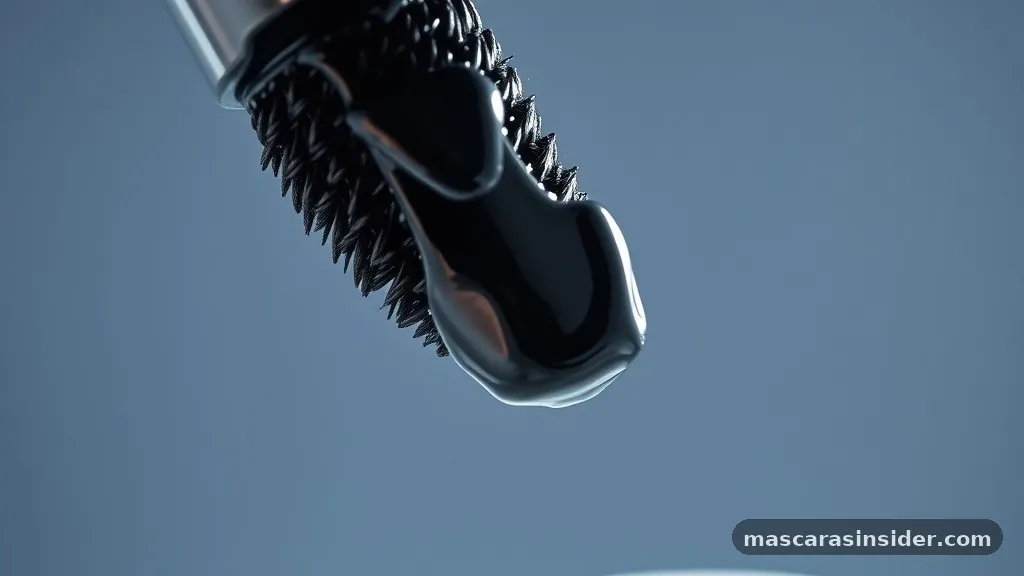
Reach for your mascara tomorrow morning and you’re holding a surprisingly complex little tube. That dark liquid isn’t just “black stuff” — it’s a carefully balanced mix of pigments, waxes, oils, and preservatives, each doing a specific job. Some ingredients make lashes look longer.
Others keep the formula from drying into a crusty mess after a week. And a few have sparked genuine controversy over the years.
So what is in mascara, really? Let’s open the tube and look at what goes into one of the world’s most popular beauty products.
What Is in Mascara at Its Core
Most mascaras are built on the same basic skeleton, no matter the brand or price. Roughly speaking, a formula contains pigment for color, wax to hold shape, oils and solvents to control texture, film-formers to coat the lash, preservatives to stop bacteria, and thickeners to give the whole thing body.
Water is usually the number one ingredient in a standard water-based mascara. It acts as the base that carries everything else.
When the mascara is exposed to air on your lashes, the water begins to evaporate, and the remaining film sets into place. That’s why an old tube goes clumpy — too much water has already escaped.
The main ingredient by function, though, is the pigment. Nearly every dark mascara owes its color to one thing.
“Carbon black is one of the most widely used colorants in eye cosmetics because it produces an intense, opaque black at very low concentrations,” notes guidance from cosmetic chemistry references.
Here’s a rough breakdown of what a typical tube contains and why each part is there.
| Ingredient group | Common examples | What it does |
|---|---|---|
| Solvent / base | Water, or oils in waterproof formulas | Carries other ingredients, sets the texture |
| Pigment | Carbon black, iron oxides | Gives lashes their color |
| Waxes | Beeswax, carnauba wax, paraffin | Adds thickness, holds the shape |
| Film-formers | Acrylate polymers, shellac | Coats and clings to each lash |
| Preservatives | Parabens, phenoxyethanol | Prevents bacterial growth |
| Conditioners | Panthenol, vitamin E, oils | Softens and cares for lashes |
The Pigments That Give Mascara Its Colour
Black rules the mascara world. And that deep black nearly always comes from carbon black, a fine powder made by burning petroleum or coal-derived materials under controlled conditions. It’s incredibly effective — a small amount produces a rich, saturated black that shows up on even the palest lashes.
Brown and colored mascaras rely on iron oxides instead. These mineral pigments give warmer, softer tones. Some funkier shades use ultramarines or other approved colorants for blues, greens, and purples.
Carbon black has drawn scrutiny, partly because of how it’s manufactured. In the United States, the Food and Drug Administration permits it in cosmetics but sets purity limits, especially around trace impurities left over from production.
The European Union has stricter rules on certain forms of it. If you’d rather steer clear, look for mascaras that skip synthetic pigments in favor of natural alternatives, though the trade-off is often a less intense black.
You may also spot the term “coal tar” floating around ingredient debates. Coal tar dyes are a separate category of synthetic colorants, and while they appear in some cosmetics, quality eye products generally lean on the pigments above rather than harsh tar-based dyes.
Waxes and Oils: The Body Builders
Ever wonder why mascara coats your lashes so evenly and stays put? Waxes. They’re the structural backbone of the formula, giving it enough substance to cling and build without sliding off.
Two waxes show up again and again:
- Beeswax — a natural wax that thickens the formula and helps it adhere to lashes. Because it comes from bees, it’s not vegan, which matters to a lot of shoppers.
- Carnauba wax — harvested from the leaves of a Brazilian palm, this is one of the hardest natural waxes known. It adds stiffness and helps lashes hold a curl.
- Paraffin and synthetic waxes — petroleum-derived options that offer consistency and a smooth glide.
Oils balance out all that wax. Without them, mascara would dry too stiff and crack.
Ingredients like mineral oil, castor oil, or plant-based oils keep the texture creamy and workable. Castor oil pops up a lot because it’s thick and is often marketed as conditioning for lashes, though the evidence that it dramatically grows lashes is thin.
The wax-to-oil ratio is basically what separates a lengthening mascara from a volumizing one. More wax equals a bigger, bolder look. More balance means a defined, natural finish.
What Makes Waterproof Mascara Different
Regular and waterproof mascaras look nearly identical in the tube, but they behave very differently the moment water hits them. The secret is in the solvent and the film-forming ingredients.
Standard mascara is water-based, so it comes off easily with a splash and some cleanser. Waterproof mascara swaps much of that water for oils and volatile solvents that repel moisture. It also leans heavily on film-forming polymers and dimethicone-type silicones that create a flexible, water-resistant coat around each lash.
That’s great at a beach or during a good cry. The downside? It’s tough to remove.
You usually need an oil-based cleanser or a dedicated bi-phase remover, and scrubbing at waterproof mascara can tug out lashes over time. Many dermatologists suggest saving it for occasions when you truly need it rather than daily wear.
Another quirk: waterproof formulas tend to flake less during the day because they don’t rely on water that evaporates. On the flip side, they can feel drier and more brittle on the lash.
Ingredients Worth Watching Out For
Not everything in mascara is beloved. Since you’re applying it millimeters from your eye, a little caution makes sense. Here are the ingredients people most often ask about or try to avoid.
- Parabens — common preservatives (methylparaben, propylparaben) that fight bacteria. They’re effective and permitted, but some shoppers avoid them over debated hormone-related concerns.
- Formaldehyde-releasing preservatives — ingredients that slowly release small amounts of formaldehyde to preserve the product. These can irritate sensitive eyes.
- Prostaglandin analogs — found in some lash-growth mascaras. They can genuinely lengthen lashes but may cause eye redness or, rarely, darkening of the eyelid skin.
- Fragrance — usually unnecessary in an eye product and a frequent trigger for irritation.
- Retinyl acetate / retinol — occasionally added; something to be mindful of, particularly during pregnancy.
The good news is that mascara is one of the more heavily regulated cosmetics. For a deeper look at how ingredients are reviewed, the U.S. Food and Drug Administration’s eye cosmetic safety page lays out the rules and offers practical guidance.
One habit matters more than any single ingredient: toss your mascara after about three months. Bacteria love the dark, moist tube, and an old one is a genuine eye-infection risk regardless of how “clean” the formula claims to be.
The Bat Poop Myth and Other Animal Questions
Let’s settle this one, because it comes up constantly. Is mascara made from bat poop? No.
It never has been. The myth likely tangled up “guano” (bat droppings) with “guanine,” a shimmery ingredient sometimes used in cosmetics that’s actually derived from fish scales, not bats.
So there’s the real answer to the animal question. Guanine, when used, comes from the scales of certain fish and creates a pearly, light-reflecting effect. It’s not in most modern mascaras, but it’s the kernel of truth behind the poop rumor.
Genuine animal-derived ingredients you might actually find include:
- Beeswax — from bees, as mentioned, common as a thickener.
- Carmine — a red pigment made from crushed cochineal insects, more common in tinted or red-toned products.
- Lanolin — a wax from sheep’s wool, occasionally used to condition.
- Guanine — fish-scale derived, for shimmer.
If avoiding these matters to you, plenty of vegan mascaras exist. They swap beeswax for candelilla or synthetic waxes and skip carmine and guanine entirely. Just remember that “vegan” and “cruelty-free” aren’t the same claim — one is about ingredients, the other about animal testing.
How to Read a Mascara Ingredient List
Flip a tube over and the ingredient list can look like alphabet soup. A few pointers make it easier to decode.
Ingredients appear in order of concentration, so whatever sits at the top makes up the biggest share. If water (aqua) leads, you’ve got a water-based formula. If you see a run of oils and silicones up top instead, it’s probably waterproof.
Colorants usually appear at the end, often listed with “CI” numbers. Carbon black shows up as CI 77266.
Iron oxides are CI 77491, 77492, and 77499. Spotting these tells you exactly where the color comes from.
If a clean or minimal formula is your goal, shorter lists are generally easier to vet than sprawling ones packed with unfamiliar names. That said, a long list isn’t automatically bad, and a short one isn’t automatically safe. Function matters more than length.
Frequently Asked Questions
What is the main ingredient in mascara?
In most standard water-based mascaras, water is the largest ingredient by volume, acting as the base. The key functional ingredient, though, is the pigment — usually carbon black — which delivers that intense dark color. Waxes like beeswax and carnauba come next and give the formula its body.
Is mascara really made from bat poop?
No. That’s a persistent myth born from confusion between “guano” (bat droppings) and “guanine,” a shimmery ingredient sometimes derived from fish scales. No mascara uses bat poop.
What ingredients should I avoid in mascara?
If you have sensitive eyes, watch for fragrance, formaldehyde-releasing preservatives, and certain lash-growth compounds like prostaglandin analogs that can cause irritation. Some people also prefer to skip parabens. Above all, avoid using any mascara past roughly three months, since bacteria buildup is a bigger risk than most single ingredients.
What animal byproducts might be in mascara?
Common ones include beeswax and lanolin as conditioners, carmine (from cochineal insects) as a red pigment, and guanine (from fish scales) for shimmer. Vegan mascaras replace all of these with plant-based or synthetic alternatives.
Is drugstore mascara safe compared to high-end?
Generally, yes. Drugstore and luxury mascaras are regulated under the same cosmetic rules and often share very similar core ingredients. You’re frequently paying for the brush design, packaging, and branding rather than a dramatically different or safer formula.
The Bottom Line
Mascara is a small product doing a lot of quiet chemistry. Water or oil forms the base, carbon black or iron oxides supply the color, beeswax and carnauba wax build the volume, and film-formers help it cling to every lash. Preservatives keep it usable, and a handful of conditioning oils keep it smooth.
Knowing what is in mascara puts you in charge. You can decide whether waterproof staying power is worth the harder removal, whether a vegan formula fits your values, and which ingredients you’d rather skip.
And you can finally retire the bat-poop story for good. Read the label, replace your tube every few months, and pick the formula that actually suits your eyes.